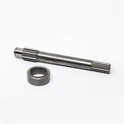
Selecting suitable precision components requires a core focus on the industry application scenario, combining functional requirements, precision level, material properties, and environmental adaptability for a systematic matching process.
Different industries have significantly different performance requirements for components; blind selection can easily lead to cost waste or system failure. The following are selection logics and key considerations based on typical industries:
Medical Equipment Field: A Balance of Precision and Biocompatibility
Typical Applications: Surgical robot joints, CT scanner slip rings, implantable device connectors
Core Requirements: Machining accuracy within ±0.005mm, ensuring millimeter-level precision.
Materials must meet biocompatibility standards (e.g., medical-grade titanium alloys, PEEK).
Surface finish Ra≤0.2μm, reducing the risk of bacterial adhesion.
Selection Recommendations: Prioritize suppliers with cleanroom production capabilities and verify their ISO certifications. 13485 Medical Quality System Certification
New Energy Vehicles and Power Systems: High Reliability + High-Volume Consistency
Typical Applications: Motor rotors, battery module structural components, electronic control unit heat dissipation substrates
Core Requirements: Batch-to-batch dimensional fluctuations controlled within ±0.01mm, ensuring assembly interchangeability; High temperature resistance (>150℃), vibration resistance, adaptable to complex working conditions; Support for rapid prototyping and iteration in small to medium batches.
Selection Recommendation: Focus on whether the supplier has SPC process control capabilities and automated testing equipment.
Semiconductor and Vacuum Environment: Ultra-clean and Low Escape Rate
Typical Applications: Wafer transfer arms, vacuum chamber sealing flanges, electrostatic chuck assemblies
Core Requirements: No particle shedding on the surface, meeting Class 10 cleanliness standards; Low material escape rate (e.g., 316L stainless steel after electrolytic polishing); Matching thermal expansion coefficients to avoid temperature deformation affecting alignment accuracy.
Selection Recommendation: Require the provision of material test reports and cleanliness test data under vacuum conditions.