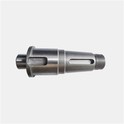
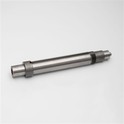
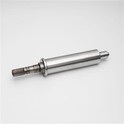
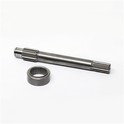
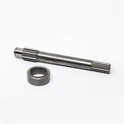
The core function of precision machining components is to achieve high-precision, high-stability motion control, signal transmission, or structural support. They are widely used in high-end manufacturing to ensure equipment performance and reliability.
These components, machined with micron- or even nanometer-level precision, meet stringent requirements for dimensional tolerances, surface finish, and material properties, playing crucial roles in various types of equipment:
Precise Motion Control: For example, crossed roller bearings used in robot joints can simultaneously withstand radial and axial loads and overturning moments, achieving a repeatability accuracy of ±0.02mm, ensuring smooth, vibration-free equipment operation.
Signal and Power Transmission: In medical devices and electronic equipment, precision components act as connectors or conductive parts, ensuring stable and interference-resistant signal transmission, such as the high-precision slip ring system in CT scanners.
Structural Support and Connection: In aerospace and automotive manufacturing, they are used in critical structural components such as aircraft frames and engine blocks, ensuring overall strength and long-term service stability.
Functional Integration and Space Optimization: For example, crossed roller bearings can perform the functions of three separate units, integrating radial, axial, and thrust bearings, significantly saving installation space and improving system rigidity.
Adaptability to Special Environments: Special materials and processes are used for scenarios such as vacuum (semiconductors), cleanrooms (medical), and high-load applications (industrial robots) to ensure reliable operation of components under extreme conditions.
With the development of intelligent manufacturing, precision components are evolving towards higher reliability, lighter weight, and greater intelligence. Some have integrated sensors for status monitoring, becoming the "sensory nerves" of intelligent equipment.