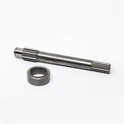
Identifying forklift components based on structural characteristics hinges on understanding the composition, layout, and morphological features of each functional module. By observing the component's installation location, connection method, motion logic, and structural design, its identity and function can be quickly and accurately identified.
Starting with Overall Structural Divisions
Forklifts employ a modular design, which can be divided into five major systems: power unit, lifting mechanism, wheeled chassis, body system, and control system. When identifying components, first locate the system to which it belongs, then refine the identification to specific components.
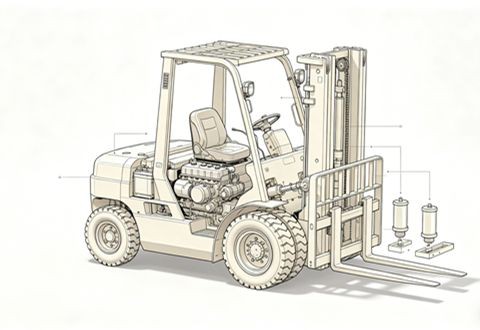
System-by-System Identification Method
Power Unit Identification
Internal Combustion Forklift Engine: Located at the rear, it includes an intake pipe, exhaust pipe, radiator, and fuel tank. It has a compact shape and a flywheel connecting to the transmission system.
Electric Forklift Battery: A large rectangular structure located under the rear of the vehicle, with exposed electrode interfaces. It also functions as a counterweight and is a significant indicator of an electric forklift model.
Electric Motor:
Small in size and well-sealed, typically installed near the drive axle or hydraulic pump; the connecting cable is clearly visible.
Lifting Mechanism Identification:
Mast:Vertically positioned at the front of the vehicle body, composed of two nested steel frames, equipped with rollers and guide rails; it is the main channel for lifting and lowering goods.
Double-Stage Mast:Commonly found in ordinary forklifts; the lifting height is higher than the vehicle body.
Triple-Stage Mast: Used for high-headroom operations; its structure is more complex, and the visual hierarchy is more distinct.
Forks:The metal fork arms extending from the front, adjustable in spacing, often with anti-slip texture; these are the parts that directly contact the goods.
Lifting Cylinders: Vertically mounted on both sides or in the center of the mast; the piston rod connects to the inner mast; these are the actuators for hydraulic power.
Tilting Cylinders: Horizontally positioned behind the mast; they control the mast's tilt angle, ensuring transport safety.
Wheel Chassis Identification
Drive Wheels: Usually front wheels, larger in size, connected to the gearbox or hydraulic motor, bearing the main power output.
Steering Wheels: Mostly rear wheels, linked to the steering wheel via tie rods, providing flexible steering.
Braking System: Drum or disc brakes are installed inside the wheel hubs; parking brakes often use a spring-locking structure.
Transmission System:
Torque Converter: Disc-shaped, connecting the engine and gearbox to achieve automatic torque conversion.
Hydrostatic Pump and Motor: A closed hydraulic unit, without a mechanical gearbox, operating quietly, commonly found in high-end models.