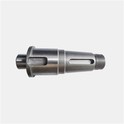
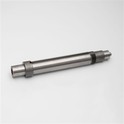
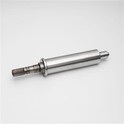
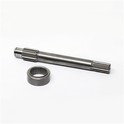
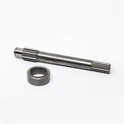
While standard motor shafts are designed for general use, servo motor shafts are engineered for high-precision, high-performance applications. The most significant difference is in their dimensional tolerances: servo shafts require much tighter control over diameter, concentricity, and straightness to ensure the motor's encoder and feedback system work accurately. They also feature specialized keyways or splines to securely connect to the load, preventing slippage that could affect positioning. The surface finish is smoother on servo motor shafts, reducing friction and wear on bearings and seals.
Another key distinction is the material and heat treatment. Servo motor shafts are often made from higher-grade steels and undergo more rigorous heat treatment processes, such as quenching and tempering, to achieve the required hardness and toughness. They may also include additional features, like threaded ends or mounting flanges, to facilitate easy integration into automation systems. Unlike standard shafts, which can tolerate minor imbalances, servo motor shafts must be perfectly balanced to avoid vibration at high speeds. This attention to detail ensures servo motors deliver the accuracy and reliability demanded by industrial automation.