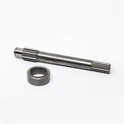
In precision machining, the choice of material directly determines the performance, lifespan, and machining efficiency of the parts. The core principle is to comprehensively match the mechanical properties and technological characteristics of the material based on the operating environment (such as stress, temperature, and corrosiveness) and machining requirements (such as precision and surface quality).
I. Material Selection by Typical Application Scenarios
1. High-Precision Transmission and Motion Components (such as gears, shafts, and worm gears)
Recommended Materials: 40Cr alloy steel, 45# steel
Reasons: 40Cr exhibits excellent comprehensive mechanical properties after quenching and tempering, high fatigue strength, and low notch sensitivity, making it suitable for medium-speed, medium-load conditions; 45# steel is low in cost and has good machinability, making it suitable for general transmission components.
Machining Points: Complex-shaped parts are prone to cracking when water-cooled; oil cooling or high-frequency surface hardening is recommended to improve wear resistance.
2. Corrosion-resistant and food-grade applications (e.g., medical devices, food processing equipment)
Recommended material: 0Cr18Ni9 (304 stainless steel)
Reason: Excellent corrosion resistance, non-magnetic, and machinable properties; meets food contact safety standards.
Machining challenges: Prone to hardening during cutting; requires sharp tools, low-speed, high-depth-cut strategy, and water-soluble cutting fluid for cooling and lubrication.
3. Lightweight structural components (e.g., robot joints, drone parts)
Recommended materials: 6061 aluminum alloy, 7075 aluminum alloy
Reason: 6061 has moderate strength and good weldability, suitable for structural frames; 7075 has strength close to steel, used for high-load components.
Machining advantages: Low cutting resistance, enabling high-speed machining, and high surface finish.
4. High Wear-Resistant Dies and Stamping Parts (e.g., punches, drawing dies)
Recommended Materials: DC53 cold work die steel, D2 steel
Reason: DC53 has good toughness, minimal deformation after wire cutting, and a lifespan twice that of SKD11; D2 has excellent wear resistance and hardenability, suitable for long-life dies.
Precautions: Avoid use in high-impact load scenarios; heat treatment processes must be controlled to prevent cracking.
5. Mass-Produced Automated Machining Parts (e.g., fasteners, electronic structural components)
Recommended Material: 10SPb20 (1.0722) free-cutting steel
Reason: The lead content significantly improves lubrication, reduces tool wear, and enhances surface finish, making it particularly suitable for high-speed turning on Swiss-type lathes.
Limitations: Not suitable for welded parts or industries with high environmental requirements (e.g., drinking water equipment).